Remote Field Electromagnetic Technique (RFET)
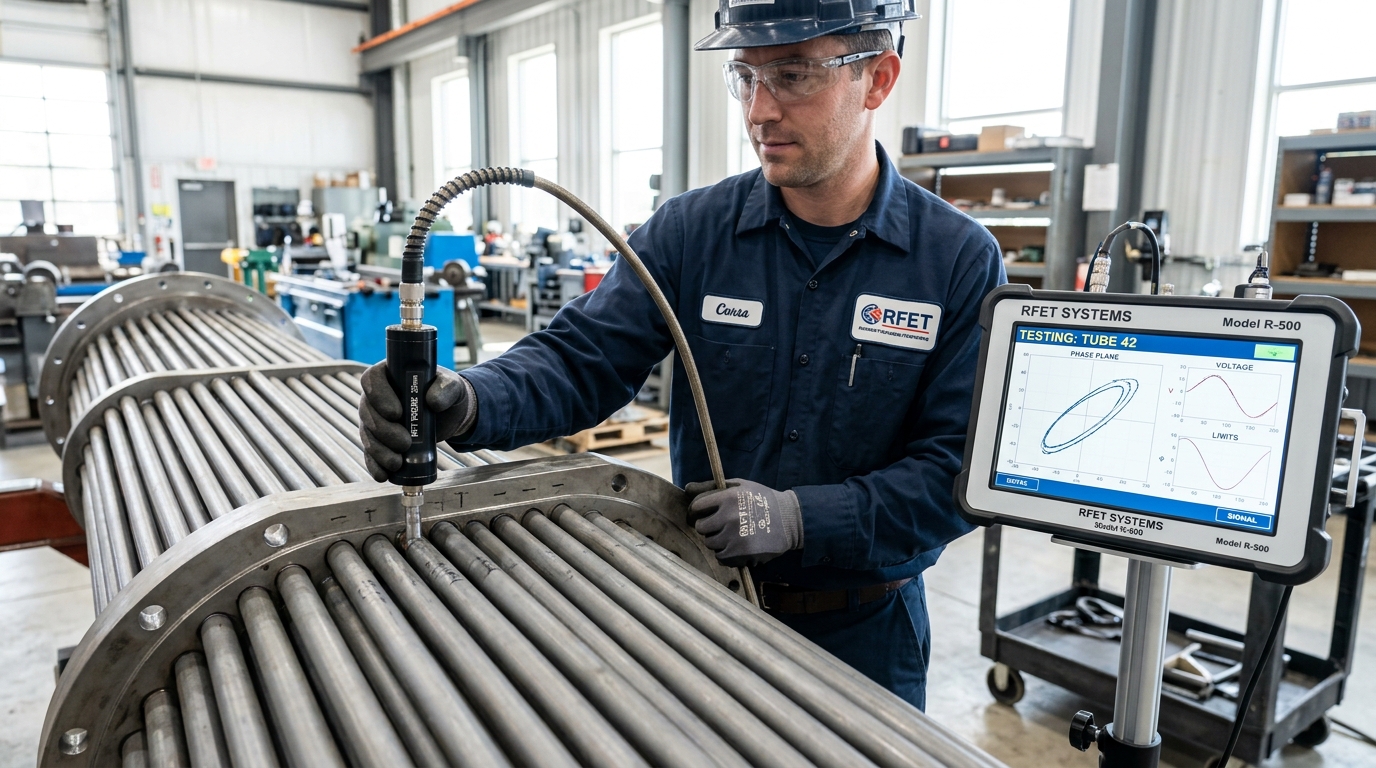
Remote Field Electromagnetic Technique (RFET), frequently designated as Remote Field Testing (RFT), is an advanced electromagnetic non-destructive testing methodology engineered expressly for inspecting ferromagnetic tubing, such as carbon steel, chrome-molybdenum, and ferritic alloys commonly utilised in steam boilers, economisers, and heavy process heat exchangers.
Due to the substantial magnetic permeability of ferromagnetic alloys, conventional eddy current testing experiences severe skin-depth attenuation and cannot penetrate the tube wall without extreme magnetic saturation. RFET resolves this through a through-transmission mechanism: an exciter coil emits a low-frequency electromagnetic field that radiates outwards through the tube wall, propagates axially along the exterior surface, and re-enters the tube wall at a distance of two to three tube diameters where sensitive detector coils record the signal.
Because the electromagnetic field traverses the tube wall twice, RFET affords balanced sensitivity to both internal (ID) and external (OD) defects. It delivers dependable quantification of general wall thinning, localised pitting, steam washing erosion, and critical wear at support plate interfaces across heavy industrial boilers and refinery exchangers.
Key Technical Highlights & Capabilities
Carbon Steel & Ferrous Penetration
Inspects heavy-wall carbon steel and chrome-molybdenum tubes without requiring heavy magnetic saturation assemblies.
Equal ID & OD Sensitivity
Dual through-wall transmission physics provides balanced flaw detection for internal erosion and external corrosion.
Support Plate Fretting Detection
Reliably detects vibration wear, erosion, and localized thinning occurring directly beneath support baffle plates.
Quantitative Wall-Loss Measurement
Calibrated phase-lag calculations deliver dependable remaining wall thickness percentages compliant with ASME Section V.
Require Remote Field Electromagnetic Technique (RFET) for Your Facility?
Contact our experienced Level III inspection specialists for technical consultation, procedures, or expedited site mobilisation.